
As warehouse operations evolve, one theme seems to rise to the surface: fleets need more flexibility. For facilities operating lithium forklift batteries or transitioning to lithium systems, the ability to charge during natural downtime has become a major competitive advantage.
That’s where MTC’s Opportunity Charging Support Systems come in. Our in‑house engineers create solutions that let facilities add opportunity charging safely and efficiently to their daily workflow. We are doing this because opportunity charging is driving a strategic shift in motive power management.
What Is Opportunity Charging for Forklift Batteries and How Does It Work?
Opportunity charging forklift batteries simply means giving short charges throughout the day. No more waiting for a full discharge or relying on a long overnight charge.
Here’s how it functions in a real operation:
- short, frequent charging windows take place during breaks, shift changes, or idle moments.
- high‑frequency chargers deliver controlled boosts without overheating or damaging the battery.
- battery management systems – (such as our CCA System) monitor temperature, voltage, and charge level to prevent overcharging.
- operators connect the truck during short breaks and return to work without swapping batteries or disrupting workflow.
The result is a fleet that stays productive longer, with less charging‑zone congestion and strain on battery assets.
Why MTC Builds Opportunity Charging Support Systems
As more facilities step away from conventional charging and adopt opportunity charging, the need for safe, organized, and code-compliant infrastructure becomes increasingly critical. And as chargers move out of battery rooms into active work areas, teams design their supporting infrastructure for safety, accessibility, and long‑term reliability.
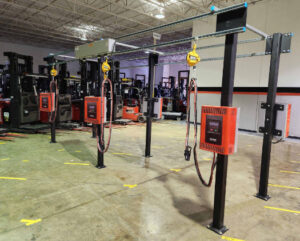
MTC manufactures the support equipment and also serves as the full‑service designer of the charging environment. Our team creates layouts that optimize safety, workflow, and future capacity.
For facilities that want turnkey support, MTC can do that, too. We offer professional installation and ongoing maintenance through our service plans. Ensuring every system performs as intended from day one.
Each component is engineered to solve specific challenges.
- Custom mounting structures keep chargers spaced correctly. They also protect them from impact and place them at an ergonomic height for frequent plug‑ins.
- Heavy‑duty cable management keeps cords organized and out of high-traffic areas. It also reduces wear, eliminates trip hazards, and minimizes operator frustration.
- Ventilation layouts that support the thermal and airflow needs of lithium charging equipment, ensuring chargers operate efficiently and safely.
- MTC’s modular designs allow facilities to scale their charging zones as their lithium adoption grows and evolves.
MTC’s Opportunity Charging Support Systems aren’t just hardware – they’re workflow tools. MTC pairs engineered equipment with professional space design, installation, and maintenance. This helps facilities adopt opportunity charging without adding chaos, clutter, or safety risks. It can help create a cleaner and more efficient fast-charging environment that supports long-term success.
Connecting to the Lithium Transition: Park & Charge Is the Future
In a previous blog comparing lithium and lead‑acid batteries, we highlighted the key advantages of lithium technology. These include faster charging, deeper cycling, cooler operation, and dramatically reduced maintenance.
Those benefits align perfectly with opportunity charging.
Lithium batteries support fast, frequent, partial charges, making them ideal for Park & Charge environments. As more facilities transition to lithium, opportunity charging becomes not just helpful, it becomes the default operating model.
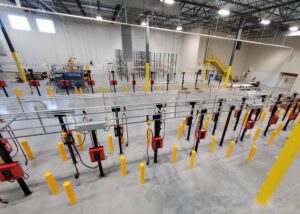
MTC’s Opportunity Charging Support Systems give facilities the infrastructure they need to:
- adopt lithium Park & Charge layouts without redesigning their entire battery room.
- maintain safe cable routing for their higher‑power lithium chargers.
- organize charging zones that support mixed fleets during the transition period.
- future‑proof their motive power strategy as lithium adoption accelerates.
This is where MTC shines: designing a possible opportunity with physical systems that offer modern charging strategies.
Why Opportunity Charging Matters in 2026 and Beyond
Several real‑world operational pressures are driving the shift toward opportunity charging.
Warehouses are pushing for higher throughput, navigating persistent labor shortages, and running more multi‑shift schedules than ever before. At the same time, the rapid rise of lithium motive power technology is reshaping expectations. Together, these forces are driving facilities to rethink how and when their forklifts receive power. Revealing why traditional charging models may no longer keep pace with modern demand.
Facilities that adopt opportunity charging gain measurable advantages across their operation. Lithium fleets see more uptime and fewer battery swaps. They also gain longer battery life and more predictable workflows thanks to consistent partial‑charge cycles throughout the day.
When paired with MTC’s engineered support systems, these benefits scale safely and efficiently. Purpose‑built mounting, cable management, and charging‑zone organization give facilities the structure they need to bring opportunity charging into daily operations and support long‑term growth.
The Bottom Line
Opportunity charging is no longer a niche strategy; it is a cornerstone of modern lithium fleet management. MTC delivers the structure, safety, and reliability a facility needs to make opportunity charging work. Whether it’s upgrading its lithium fleet or making a full transition, they need our Opportunity Charging Support Systems.
Opportunity charging – the bridge between today’s operations and tomorrow’s fully optimized Park & Charge environments.